
Shipping a car to Costa Rica
A guide for US owners moving a vehicle south, covering how the car travels, what customs charges duty on, and the paperwork you'll need to clear it.
Read more shipping news and updates See what drives freight ratesHow a vehicle actually moves from your driveway to a Costa Rican licence plate
Shipping a car isn't one transaction, it's a sequence of checks and handoffs, and each one has to clear before the next can start. Here's the order they happen in, and where the process branches depending on your vehicle and your choices.
-
Choose how the car travels
Vehicles cross by one of two methods: Roll-on/Roll-off (RoRo), where the car is driven onto a specialised vessel and secured on deck or in a hold, or by container, where it's loaded and locked inside a Full Container Load (FCL). The choice affects cost, handling risk, and what else you can ship alongside it.
RoRoThe car is driven on and off. Fewer handling steps, but the vehicle travels exposed to the elements and to other traffic on the vessel.
ContainerThe car is secured inside a sealed container, often alongside personal belongings. More protection, and it can double as your household shipment.
-
File the customs declaration
Once the vehicle arrives, your customs broker (agente aduanal) submits the import declaration through TICA, Costa Rica's customs platform, on your behalf. They can't start until you've handed over the title, the Bill of Lading, and the other documents the declaration depends on, so gathering paperwork before the ship departs saves time at this stage rather than after it.
-
Valuation and duty are set
Once the declaration is filed, the vehicle's customs value is worked out under rules set by the Ministerio de Hacienda, and the import duty owed is calculated on that value. The duty has to be paid before the file can move forward, so this is the stage where the cost you budgeted either holds or needs revisiting.
-
Pass the vehicle technical inspection (RTV)
Before a vehicle can be registered for use on Costa Rican roads, it goes through the revisión técnica vehicular (RTV), the national vehicle inspection that checks roadworthiness. This happens after customs clearance, because the car has to be legally in the country first.
Passes inspectionYou move on to registration.
Fails inspectionThe issues flagged have to be fixed and the vehicle re-inspected before registration can proceed.
-
Register the vehicle
Registration is the last step, and it's what turns a cleared, inspected import into a car you can legally drive and insure in Costa Rica. It depends on everything before it going through cleanly: the customs declaration, the duty payment, and the inspection pass all have to be in hand.
Individual cases vary with the vehicle's condition, its paperwork, and the broker handling the file.
How your car's age changes what customs charges you
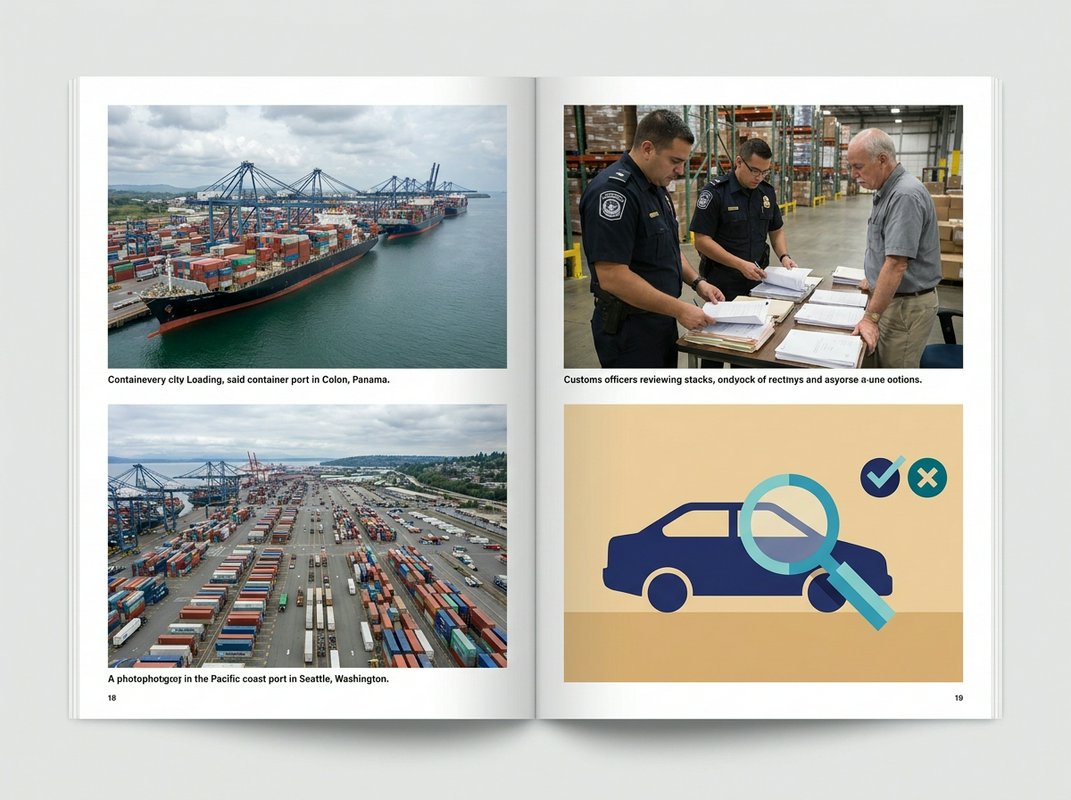
Costa Rica's finance ministry, the Ministerio de Hacienda, sets the rules for how an imported vehicle is valued at customs. For a used car, that valuation is reduced according to the car's age, so a ten-year-old sedan and a two-year-old one of the same model are not valued the same way for tax purposes.
This matters because import duty is charged on the customs value. An older car is usually valued lower under the Ministerio de Hacienda's depreciation schedule, and a lower value generally means a lower duty bill. A newer car holds more of its value in that schedule, and so carries more duty.
What this means for budgeting
- The year of manufacture on the title is what the valuation is built from, so it is worth confirming that figure before you estimate anything.
- Two cars that cost the same in the US can end up with different duty bills in Costa Rica, purely because of the manufacture date.
- A shipping quote from a carrier will not include this figure. It covers freight, not the customs valuation or the tax that follows it.
Working out the likely duty on a specific car, given its age and declared value, is a calculation a customs broker can run before the vehicle ships. That is the point to ask.
RoRo vs container shipping for your car
Which method suits your car usually comes down to whether it runs, what it's worth, and whether you're shipping anything alongside it.
| Shipping method | Best for | Watch out for | Transit time |
|---|---|---|---|
| RoRo (Roll-on/Roll-off)The vehicle is driven onto the vessel and secured for the voyage. | Standard, drivable cars, SUVs and motorcycles in running order | The vehicle must start under its own power and arrive empty of personal belongings | Generally the more direct route, though it still depends on the vessel's port calls |
| Shared containerThe vehicle travels inside a sealed container alongside another shipper's cargo. | Non-running or classic vehicles where sharing container space keeps the cost down | Your departure date depends on another shipper filling the rest of the space | Can take longer to depart, since the container doesn't sail until it's full |
| Dedicated container (FCL)The container holds only your vehicle, sealed for the full journey. | Higher-value, non-running or modified vehicles, or a car shipped alongside packed household effects | You pay for the full container regardless of how much of it the vehicle actually occupies | Departs on its booked schedule, without waiting on other cargo to fill the space |
This is general guidance on how the two methods differ. Availability of each method varies by carrier and departure port, so confirm the options for your specific route before booking.
What import duty actually costs on a car
Costa Rica does not tax a vehicle on what you paid for it in the US. It taxes the CIF value, which stands for cost, insurance and freight: the car's value plus whatever it cost to insure and ship it to a Costa Rican port. A cheap car with an expensive shipping bill and a car bought for more but shipped more cheaply can end up taxed at close to the same figure, because the freight cost is folded into the number the duty is calculated on.
Why the age of the car matters here too
Costa Rica does not use the price on your bill of sale to set that value in the first place. Customs works from reference values for the make, model and year, adjusted for the vehicle's age, and those values are set by the Ministerio de Hacienda, Costa Rica's finance ministry. TICA is the platform a declaration is filed through rather than where the figures come from. A newer car is taxed on a higher assumed value than an older one of the same model, which is part of why the duty percentage alone does not tell you much until you know what value it is being applied to.
The duty rate itself varies by the vehicle's characteristics and is set against the vehicle's HS code (Harmonised System Code), the classification customs uses to identify exactly what kind of goods are being declared. Treat the rate as something to confirm against the current TICA schedule for your specific vehicle before you commit to shipping it.
Building a realistic total
The number to budget is not the duty alone. A realistic total adds the shipping cost itself, the duty calculated on the CIF value, and the fees for the customs broker (agente aduanal) who submits your declaration to TICA, plus the inspection and registration costs that come after the car clears the port. Skipping any one of these when you plan is the most common way people underestimate what landing a car in Costa Rica actually costs.
Because the reference values and duty schedules TICA applies can change, it is worth checking the current figures directly against the official source before you book shipping. The customs clearance guide walks through how declarations and duty calculations work for imports generally, and the glossary is a quick place to check any term here you have not met before.
Sources, last reviewed 5 October 2026: Costa Rica customs regulations, International Trade Administration; Costa Rica import tariffs, International Trade Administration; Apostille Convention status table, HCCH.
Documents to gather before you ship your car
Vehicle imports draw extra scrutiny at customs, so having each document ready before the car leaves the US saves days at the Port of Caldera or Port of Limón.
-
Original vehicle title
The title must be in the name of the person shipping the car, or accompanied by a notarised bill of sale showing the transfer.
-
Bill of sale
Needed if the title is not already in your name, or if the vehicle was bought from a dealer.
-
Copy of your passport or ID
Customs matches the importer named on the shipping documents against the person clearing the vehicle, so the names need to line up.
-
Bill of Lading
The carrier issues this once the car is loaded; it's the shipping document your customs broker (agente aduanal) needs to begin the declaration.
-
Proof of the vehicle's value
A purchase invoice, a bill of sale with a stated price, or an appraisal is used to establish the CIF value that duty is calculated on.
-
Apostille for US documents
Where a US document such as the title needs official certification for use in Costa Rica, that is an apostille issued in the US, not a consulate visit. Your customs broker will tell you which documents need one.
-
Power of attorney for your customs broker
If you won't be in Costa Rica to clear the vehicle yourself, your broker will need signed authorisation to act on your behalf.
Exact requirements can vary by broker and by the vehicle's history, so confirm the current document list with your agente aduanal before the car ships. The customs clearance guide walks through what happens to these documents once the vehicle arrives.
Common questions about shipping a car to Costa Rica
How does a car's age affect what I pay in import tax?
Costa Rica's finance ministry, the Ministerio de Hacienda, sets how an imported vehicle is valued for customs, and that valuation is reduced according to the car's age. Duty is charged on that value, so an older car is usually valued lower and taxed less than a newer one of the same make. Whether a specific car can be registered once it arrives is a separate question, and it is worth raising with a customs broker before you book shipping.
Do the same rules apply to shipping a motorcycle?
Motorcycles go through the same customs process as cars, meaning a commercial invoice, a Bill of Lading, and a customs declaration submitted through TICA, Costa Rica's customs platform. They are usually shipped by container rather than RoRo (roll-on, roll-off), because a single motorcycle rarely fills a container on its own and often travels alongside other household goods.
Do I need a customs broker to import a vehicle?
You need a customs broker (agente aduanal) to submit your vehicle's import declaration to TICA. This isn't optional paperwork you can skip by doing it yourself. The broker needs your title, Bill of Lading, and commercial invoice before they can file, so having those documents ready before the vehicle lands saves time at the port.
Is the shipping cost the total cost of importing a car?
A shipping quote covers getting the car from a US port to a Costa Rican one. It does not include import duty, customs broker fees, the technical inspection, or registration, and those add substantially to what you pay overall. Budget for the full process before you commit to shipping.
Should I choose RoRo or container shipping for my car?
Roll-on, roll-off (RoRo) shipping drives the car onto the vessel and off again at the destination port, which usually costs less than container shipping. Container shipping locks the car inside, which adds protection against weather and handling but costs more and typically takes longer to arrange. Which one suits you depends on the vehicle's value and how much you want it shielded from exposure during transit.
How is import duty on a vehicle actually calculated?
Costa Rica calculates import duty on the CIF value of the vehicle, meaning the cost of the car plus insurance and freight, under valuation rules set by the Ministerio de Hacienda. A declaration based on that value is then filed through TICA, the customs platform your broker uses to submit it. The exact rate depends on the vehicle's classification, so this is worth checking against the ministry's current figures before you settle on a number in your head.