
Sea and air freight
Ocean freight (FCL and LCL) and air freight compared for the US–Costa Rica corridor, with what drives transit times and costs.
Read the sea and air freight guide →Shipping something from the US to Costa Rica means a container ship, a customs broker, and a fair bit of paperwork before it ever reaches your door. This site walks you through cost, timing, and documents for sea freight, vehicle imports, and household moves.
Read the latest shipping news and updates Compare carriers and transit timesSea freight, a car, a full household, or the customs paperwork behind any of them. Pick the one that matches what you're actually moving.
Ocean freight (FCL and LCL) and air freight compared for the US–Costa Rica corridor, with what drives transit times and costs.
Read the sea and air freight guide →How a car's age feeds into the customs valuation the import tax is charged on, and what the process involves from port to registration.
Check vehicle import rules →Packing, menaje de casa customs rules, and a door-to-door timeline for moving your household to Costa Rica.
Read the relocation guide →The documents your customs broker needs, how TICA processes a declaration, and what duty gets charged on.
Read the customs guide →Terms like Bill of Lading, HS code, and Incoterms explained in one place, for whenever you hit one mid-guide.
Look up a term →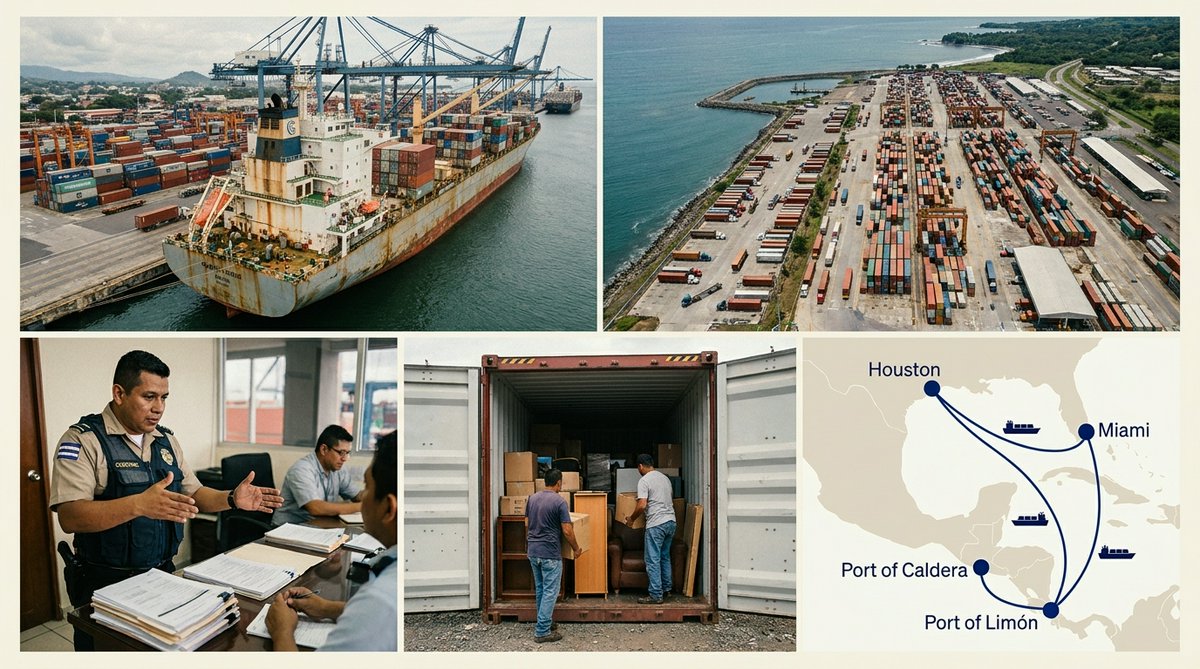
Freight moving between the US and Costa Rica travels one of a small number of set routes, and which one applies to you depends mostly on what you're shipping and how fast you need it.
Ocean freight is the route most household goods and vehicles take. It lands at one of two ports: the Port of Caldera on the Pacific side, or the Port of Limón on the Caribbean side. Which one your shipment uses depends on the carrier and the sailing schedule.
A full container to yourself is called a Full Container Load (FCL). If you don't have enough to fill one, you can share space in a container with other shippers, known as Less than Container Load (LCL). LCL costs less for a small shipment but takes longer, because the container waits until it's full enough to sail, and again at the other end while it's unpacked and sorted.
Air freight and courier services cover the other end of the scale: smaller, lighter, and faster. A courier shipment (the kind DHL or FedEx handles) is priced and processed differently from cargo freight, and the two aren't interchangeable once a shipment passes a certain weight or size.
Once a shipment reaches port, it still has to clear customs before it moves again, and that step has its own timeline on top of the sailing time. Door-to-door, that means budgeting for transit plus clearance.
The customs clearance guide walks through what happens once your shipment reaches Caldera or Limón, and the carrier comparison sets out transit times and typical costs for the carriers running this corridor.
Each of these moves goods between the US and Costa Rica by a different route, and the right one depends on how much you're sending and how soon you need it. Read across a row to see where a method fits before you go looking at carrier rates.
| Shipping method | Best for | Speed | Watch out for |
|---|---|---|---|
| Ocean freight, Full Container Load (FCL)The container is yours alone, so nothing else shares the space or the schedule. | A full container's worth of goods | Slower than air, on a fixed sailing schedule | You pay for the whole container whether or not it's full |
| Ocean freight, Less than Container Load (LCL)Your goods share container space with other shippers' cargo, which is what keeps the cost down for a partial load. | Smaller loads that don't fill a container | Slower still, since the carrier waits to fill the container | Extra handling at origin and destination can add days to clearance |
| Air freightAir cargo moves on passenger or freighter aircraft. | Time-sensitive or higher-value goods in smaller volumes | Much faster than either ocean option | Cost climbs quickly with weight, so it suits smaller volumes |
| Courier (parcel service)Couriers such as DHL or FedEx move small packages. | Individual parcels, not full households or commercial loads | Fastest door-to-door option | Handled under a separate customs process from freight, with its own weight limits |
This is general guidance on how the four methods differ. For named carriers and their transit times, service levels and booking methods on this corridor, see the carrier comparison page.
Rules and tariffs on this corridor shift from one quarter to the next, so it's worth checking where things stand before you commit to a carrier or a date.